

Staff augmentation adds engineers who work under your direction, so you own the outcome. Managed services hand a provider an ongoing function to run against an SLA. Consulting buys advice and a plan. Outsourcing hands a vendor a defined project to deliver. The real question is who needs to own the code, control access and carry the risk.
Most teams pick an engagement model by asking "how fast can you get me people?" That's the wrong first question. The better one is: when this is done, who has to own the code, who holds the keys to production, and who answers when an auditor or a big customer asks about the people who wrote it? Answer that, and the model mostly picks itself.
Quick definition before we compare: staff augmentation means a provider supplies engineers who join your team, follow your process and take direction from your leads. If you want the longer version, here's how staff augmentation works.
The Four Models at a Glance
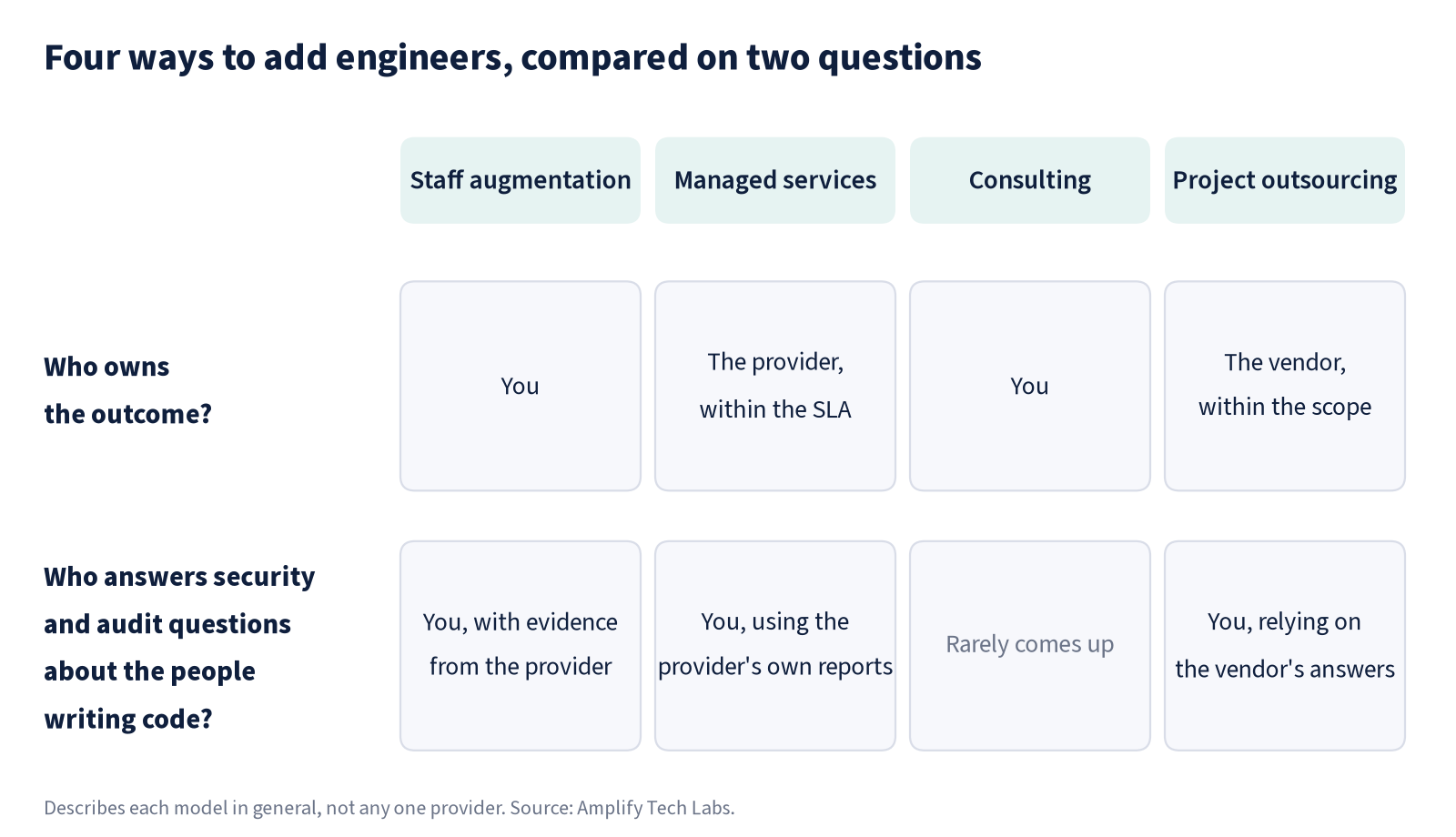
The four models differ less in who types the code and more in who's on the hook for it. Here they are side by side. The rows that matter most, and that most comparisons skip, are production access and who answers security and audit questions about the people writing your code.
A note on the table: it describes each model in general, not Amplify. What we do and don't offer is near the end.
Dimension | Staff augmentation | Managed services | Consulting | Project outsourcing |
|---|---|---|---|---|
What you're buying | People and capacity | A running function, backed by an SLA | Advice and a plan | A finished deliverable |
Who directs day-to-day work | You | The provider | You, using their advice | The vendor |
Who owns the outcome | You | The provider, within the SLA | You | The vendor, within the scope |
Where knowledge ends up | In your team and your repos | Mostly with the provider | In documents and your leaders' heads | With the vendor until handover |
Typical commercial shape | Per person, monthly or hourly | Retainer tied to an SLA | Project or retainer fee | Fixed bid or milestones |
Who holds production and customer-data access | Whoever you grant it to, under your controls | The provider's staff, under their controls | Usually no one on their side | The vendor, during the project |
Who answers security and audit questions about the people writing code | You, with evidence from the provider | You, using the provider's own reports | Rarely comes up | You, relying on the vendor's answers |
Best fit | Clear roadmap, strong tech lead, need hands | Steady, well-defined operations | Unclear direction or a big decision | Separable project with a clear finish |
Typical failure mode | No one has time to lead them | You can't explain a system you own | A good plan nobody executes | The handover cliff when the vendor leaves |
What Is the Difference Between Staff Augmentation and Managed Services?
With staff augmentation, you add engineers to your team and you run the work. With managed services, you hand a whole function to a provider, and they run it against a service-level agreement (SLA), a contract that sets the response times and uptime they're paid to hit.
So the real difference is control. Augmented engineers sit in your standups, work in your repos and follow your tech lead. A managed-services provider decides how the work gets done. You judge them on results: was the system up, was the ticket answered in time.
Both are fine. They just solve different problems. Staff aug helps when you know what to build and need more hands. Managed services help when something needs to run every day and you'd rather not staff it yourself.
What Are Considered Managed Services?
Managed services are ongoing operations a provider runs for you under an SLA. Typical examples are infrastructure monitoring, cloud operations, help-desk and application support, backups, and security monitoring. The common thread is that the work is repeatable and measurable. If you can't write down what "done well" means in an SLA, it probably isn't a good managed service.
When Managed Services Fail a Product Team
They fail when the thing you handed off is something you'll be asked about. If a provider runs your deployment pipeline and your biggest customer's security team asks how code reaches production, "our vendor handles that" is a weak answer.
The other failure is knowledge. After a year, the people who understand how your system actually behaves at 2 a.m. work for someone else. That's fine for backups. It's a problem for the core of your product.
Staff Augmentation vs. Outsourcing: What Are the Key Differences?
Staff augmentation gives you people who build under your direction. Outsourcing gives a vendor a defined project, and they decide how to build it and hand you the result. With staff aug you own the outcome every day. With outsourcing you own it again on the day the vendor leaves.
Outsourcing works well when the project is genuinely separable: a marketing site, a one-off data migration, a prototype you'll throw away. It gets risky when the "project" is really the core of your product, because the people who understand it best are about to walk out the door.
If you do have a separable build, that's what end-to-end product development is for. Just go in knowing who keeps the system afterward.
Who Owns the Code and the IP
Don't assume. In most engagements the client expects to own the code, but what actually decides it is the contract: look for an IP assignment clause, how pre-existing vendor code and libraries are licensed to you, and when ownership transfers (on payment, on delivery, or as it's written). This isn't legal advice. Have your lawyer read that section before you sign, not after a dispute.
With staff aug the code lives in your repositories from the first commit, which makes ownership easier to see. With outsourcing it often lives in the vendor's repo until handover, so check when and how you get it.
On our staff augmentation placements, you own the code and IP each engineer writes.
The Handover Cliff When a Project Vendor Leaves
The handover cliff is the moment a project vendor finishes and your team inherits a system it didn't build. The code compiles. The docs exist. But the reasons behind a hundred small decisions leave with the vendor's team.
You can soften it. Put your own engineer on the project from week one. Insist on code reviews in your repo, not a zip file at the end. Budget a few weeks of overlap where the vendor's team answers questions while yours makes changes.
What Is Staff Augmentation vs. Consulting?
Consulting buys judgment. Staff augmentation buys capacity. A consultant tells you what to build, how to organize the team or which vendor to pick. Augmented engineers help you build it. The same split covers "professional services," which usually means expert advice or setup work sold by the hour or by the project.
Consulting fails in a predictable way: you get a good plan and nobody has time to execute it. Staff aug fails the other way: you get capable engineers and nobody has decided what they should build.
There's a hybrid worth knowing about. Besides placing developers, clients sometimes hire me as a fractional CPO (a part-time chief product officer) and use our developers to build their product, which I manage. If that's the kind of help you need, here's how our product consulting works.
Staff Augmentation vs. Contractors
Hiring a contractor means you find, vet, contract and pay each person yourself, and you start over if they leave. With staff augmentation, a provider handles the sourcing, vetting, payroll and replacement, and the engineer still works under your direction.
That vetting is most of the value. If you want to see what it looks like for us, here's how to vet nearshore developers, including the questions we ask. And because our engineers are in Latin America, they work in whatever US time zone you work in. More on how location affects staff augmentation.
If You're a Fintech: Who Answers Your Sponsor Bank's Questions?
You do, under every model. If you launch lending or deposit products through a sponsor bank, the bank will ask about the people who can touch your systems and customer data. The model you pick decides how easy that answer is, not whether you have to give it.
Production and Customer-Data Access Under Each Model
With staff augmentation, you grant access like you would for an employee: your identity provider, your roles, your logs. That's more work for you, but you can show a bank exactly who can see a borrower's application or a depositor's account. With managed services and outsourcing, the provider's people get access under the provider's controls, so you're relying on their reports and their offboarding.
On our staff augmentation placements, you grant production and customer-data access, not us, and you remove it when an engineer leaves.
Vendor Due Diligence and Offboarding Evidence
Expect questions like: who are these people, where are they, what checks did you run, and how do you prove access was removed when they left? For our engineers, the checks include criminal background checks and previous-employment verification. If you're working toward SOC 2, access reviews and offboarding records are part of what the auditor looks at, so keep them for contractors too.
What Regulators Expect When You Use Third Parties
Outsourcing the work doesn't outsource the accountability. Under the federal banking agencies' 2023 guidance on third-party relationships, a bank's use of a third party doesn't reduce its responsibility to operate safely and soundly and follow the law, just as if it did the work itself. Among the things a bank typically weighs, the same guidance lists how a third party picks and oversees its own subcontractors and where they're located. That's why your sponsor bank asks about your vendors as well as you. See the Interagency Guidance on Third-Party Relationships: Risk Management (Federal Reserve, FDIC and OCC, June 2023). It's written for banks, not fintechs, and this isn't legal advice; your bank's own requirements are what count.
Which Model Fits Your Team? A Decision Guide
Pick the model that matches what you're actually missing: hands, a running function, a decision or a finished project. Here's the short version:
You have a clear roadmap and a strong tech lead, but not enough engineers: staff augmentation.
You have a defined, separable project with a clear finish line: project outsourcing, with your own engineer on it from day one.
You have steady, repeatable operations you'd rather not staff: managed services.
You don't know yet what to build or how to organize the team: consulting first, then one of the others.
You'll be asked about it by an auditor or a big customer's security team: keep it close, which usually means staff augmentation or in-house.
How Amplify Fits
Here's the honest version. We place senior Latin American engineers on US teams through our staff augmentation service, build products end to end, and do product consulting, including fractional CPO work. If another model fits you better, I'd rather tell you that up front.
FAQ
What is the difference between staff augmentation and managed services?
With staff augmentation, you add engineers to your team and you run the work. With managed services, you hand a whole function to a provider, and they run it against a service-level agreement (SLA). The real difference is control: augmented engineers follow your tech lead, while a managed-services provider decides how the work gets done.
What are the key differences between staff augmentation and outsourcing?
Staff augmentation gives you people who build under your direction. Outsourcing gives a vendor a defined project, and they decide how to build it and hand you the result. With staff aug you own the outcome every day. With outsourcing you own it again on the day the vendor leaves.
What is staff augmentation vs. consulting?
Consulting buys judgment. Staff augmentation buys capacity. A consultant tells you what to build, how to organize the team or which vendor to pick. Augmented engineers help you build it. Consulting tends to fail when nobody has time to execute the plan; staff aug fails when nobody has decided what to build.
What are considered managed services?
Managed services are ongoing operations a provider runs for you under an SLA. Typical examples are infrastructure monitoring, cloud operations, help-desk and application support, backups, and security monitoring. The common thread is that the work is repeatable and measurable. If you can't write down what "done well" means, it probably isn't a good managed service.
How do I choose between staff augmentation, managed services, consulting and outsourcing?
Pick the model that matches what you're missing. A clear roadmap but too few engineers points to staff augmentation. A defined, separable project points to outsourcing. Steady, repeatable operations point to managed services. If you don't know yet what to build, start with consulting. Anything auditors will ask about, keep close.
Which engagement model is best for a fintech team that works with a sponsor bank?
Usually the one that lets you show the bank who can access your systems and customer data. Under every model, you still answer your sponsor bank's questions. Staff augmentation keeps access under your own controls and records, which makes those answers easier. Outsourcing and managed services make you rely on the provider's reports.
Next Step
Before you talk to any vendor, write down who has to own the code, the access and the audit answers. Then pick the model that fits that list. Not sure which one fits? Talk to us, or see how we run staff augmentation for software teams.
Peter Hwang is the founder and CEO of Amplify Tech Labs. He's spent 20 years as a product manager, mostly at digital-only startups that originate and service financial products, and now places senior Latin American engineers with US fintechs and works as a fractional CPO.