

At Amplify Tech Labs, a junior Latin American developer costs $35 to $40 an hour. Mid-level is $45 to $55, and senior is $60 to $65. That's our published $35 to $65 band, split by experience. Each level is in line with the market: inside the range for juniors and mid-level engineers, and at the low end for seniors.
A full-time US software developer costs a lot more than their salary. Using the same math as our developer cost calculator (US Bureau of Labor Statistics salary, plus employer taxes and benefits, divided by about 1,880 hours actually worked after paid time off), a US employee costs:
Junior: $54 to $61 an hour, vs. our $35 to $40
Mid-level: $86 to $93 an hour, vs. our $45 to $55
Senior: $108 to $115 an hour, vs. our $60 to $65
That's before recruiting, equipment or management time.
These are the rates we charge when we place Latin American engineers on US teams, often in fintech. Our hourly rate is the whole cost: no benefits, payroll taxes or recruiting fees on top.
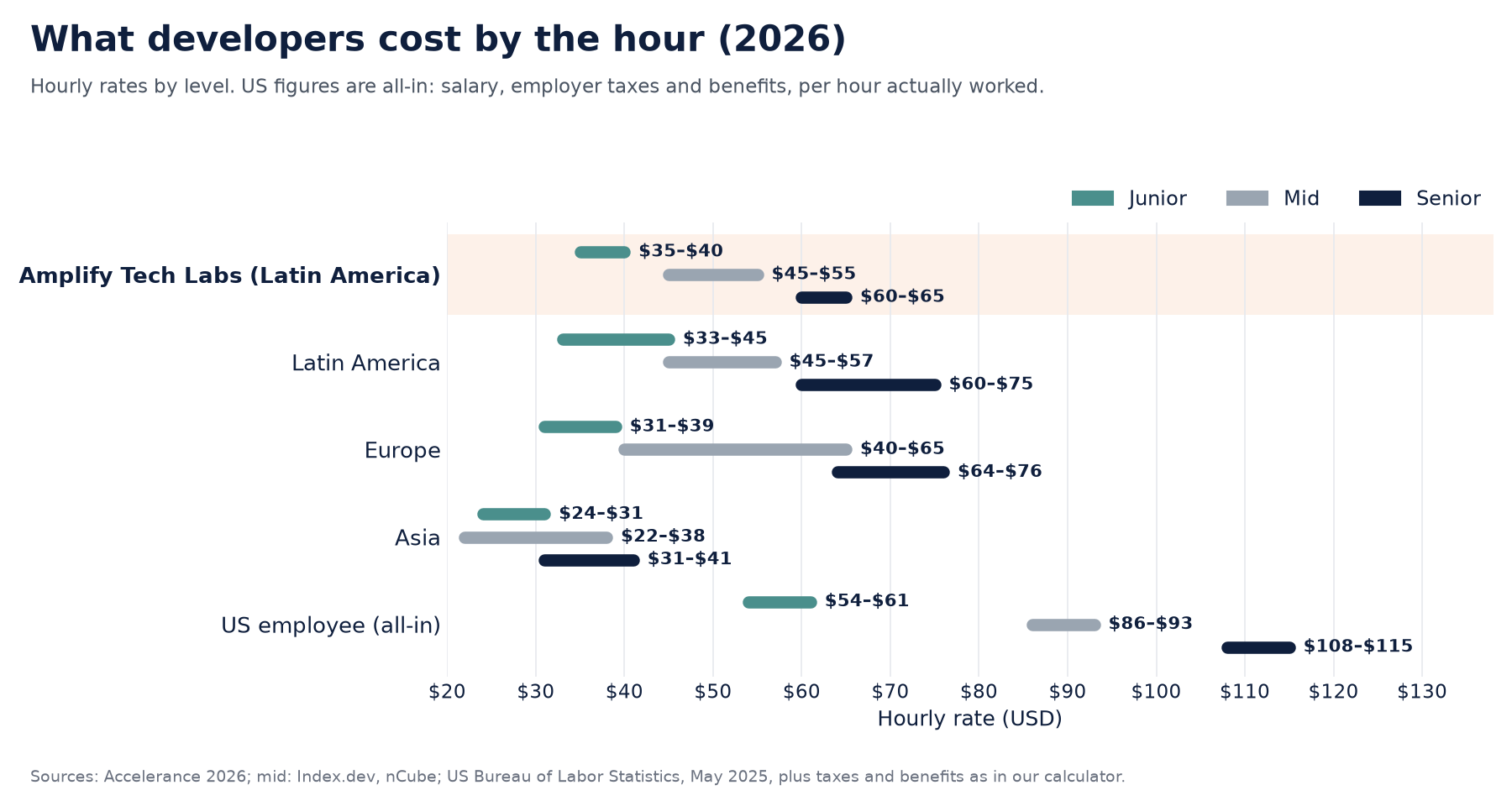
Nearshore means engineers in a nearby time zone who work under your direction. They usually come through a staff-augmentation partner: a firm that finds and employs the engineer, while you direct the work. The table below puts our rates next to the market in Latin America, Europe and Asia, and next to what a US employee costs all-in.
Region | Junior (hourly) | Mid (hourly) | Senior (hourly) | Source |
|---|---|---|---|---|
Amplify Tech Labs (Latin America) | $35-$40 | $45-$55 | $60-$65 | |
Latin America, market rate | $33-$45 | $45-$57 | $60-$75 | |
Europe, market rate | $31-$39 | $40-$65 | $64-$76 | |
Asia, market rate | $24-$31 | $22-$38 | $31-$41 | |
US employee, all-in (salary, taxes, benefits) | $54-$61 | $86-$93 | $108-$115 | US Bureau of Labor Statistics May 2025; employer taxes and benefits as in our developer cost calculator |
How Much Does It Cost to Hire a Software Developer?
It depends on whether you hire a US employee, a US freelancer, or a nearshore or offshore partner. The salary number most teams start with is only part of what a US employee costs.
US employee. A mid-level US software developer earns $135,980 a year in salary, according to the US Bureau of Labor Statistics' May 2025 wage survey. Add employer taxes and benefits and the real cost is $161,978 to $174,678 a year, or about $86 to $93 for every hour actually worked. That's still before recruiting, equipment or management. For the bigger picture on US hiring conditions, see what's happening in the US software engineer job market.
Those employer taxes and benefits are already in the figures above. A June 2026 survey from the US Bureau of Labor Statistics puts those extras at about 22.6% of salary for management and professional workers. That covers health insurance, retirement and required taxes, and leaves out overtime and bonuses. It is a group average, not a quote for one hire.
A senior US hire costs more. Start with a salary of $171,980, toward the high end of the official pay scale (three-quarters of developers earn less). Add employer taxes, workers' compensation, a typical 401(k) match, life and disability insurance, and health insurance. We used IRS payroll rules and 2026 premiums from the Kaiser Family Foundation. The total is about $202,571 a year for single health coverage, or $215,271 for family coverage, or about $108 to $115 for every hour actually worked. That is our model, not a figure the US Bureau of Labor Statistics publishes.
US freelance. Arc, a freelance marketplace, surveyed freelancers on its platform in 2026. It reports US and Canada rates of $82 to $130 an hour, and senior US freelance rates of $95 to $150 an hour. Treat those as one marketplace's figures, not a full picture of the market.
Nearshore and offshore partners. Our Latin America rates, on our staff augmentation page, are $35 to $65 an hour, by level, as in the table above. They sit inside the Latin America market range for junior and mid-level engineers, and at the low end for seniors.
Latin American Developer Rates vs. the US, Europe and Asia
Latin America sits between Asia and the US on the hourly rate, and close to Europe at the senior end. Asia is cheaper by the hour at every level. The table above has the side-by-side numbers.
Senior market rates in Latin America and Europe nearly overlap ($60-$75 vs $64-$76). A senior US employee costs about $108 to $115 an hour all-in (salary, taxes and benefits). Our senior rate of $60 to $65 sits well below that.
Here's one full-year comparison, with the math shown. A senior Latin American engineer through us, at our staff augmentation rates of $60 to $65 an hour, costs $112,800 to $122,200 a year ($60 x 1,880 hours = $112,800; $65 x 1,880 = $122,200). You only pay for hours worked, so holidays and vacation cost you nothing. A senior US employee costs $202,571 to $215,271 a year with taxes and benefits, and you pay that whether they're working or on vacation. That makes us 40% to 48% less ($122,200 vs. $202,571 is 40% less; $112,800 vs. $215,271 is 48% less). At the market's senior range of $60 to $75 an hour ($112,800 to $141,000 a year), the saving is 30% to 48%.
Why Are Asian Developer Rates Lower Than Latin America's?
Asia is cheaper by the hour. The main reason is supply, not time zone or English.
India had more than 17 million developers on GitHub in 2024. That is more than Brazil, Mexico, Colombia, Argentina and Peru put together. In 2025, India added 5.2 million more. All of Latin America added 3.2 million (GitHub Octoverse 2025). Accelerance, whose 2026 rates we use in the table above, says Asia stays the cost leader "thanks to massive talent pools in places like India, Pakistan, and Bangladesh." India's tech industry employed 5.8 million people in the year ending March 2025, according to Nasscom, which projected about 6 million a year later.
Local living costs sit under those rates. In 2025, India's GDP per person was $11,748, adjusted for local prices, according to the World Bank. Mexico's was $25,868, Brazil's $23,433 and Argentina's $32,587. A lower cost of living means a lower salary can still work for the engineer, and a lower bill rate can still work for the firm.
US demand has also pushed Latin American pay up. Everest Group found that in the year to the first half of 2024, prices for advanced IT work rose more in Mexico than in India, "due to higher demand for nearshore delivery."
The lower Asian rate is real. If the lowest hourly rate is all you are shopping for, Asia wins. We hire in Latin America at our published rates of $35 to $65 an hour. That is the market we know, and we place engineers on US fintech teams. For more on how location affects the work itself, see how location influences the success of staff augmentation.
What's Included in a Nearshore Hourly Rate
An hourly rate is what you pay per hour worked. Ours covers everything below, with nothing billed on top. Other firms vary, so ask for a plain list before you compare bids.
With us, as on our staff augmentation page, you can count on:
Vetting before you see a candidate. Several rounds of technical interviews, a take-home assignment, and a review by a senior engineer. Only a small share of applicants clear it. For the fintech version of that bar, see how we vet nearshore developers.
A short list of candidates, not a pile of resumes. Profiles, code samples and scheduling help so you can run your own interview.
Engineers who work your hours. Latin America coverage with fluent English and US business-hour overlap.
With us, equipment, local holidays, replacing an engineer who isn't a fit, and day-to-day management are all inside the hourly rate. None of it is billed on top. When you compare other quotes, ask whether theirs include the same.
Hire LatAm Developers Directly, Through a Marketplace, or Through a Partner?
You have three common paths. They differ in who vets, who pays and who replaces.
Direct hire plus an employer of record (EOR). An EOR is a local company that employs the person on paper so you do not set up a foreign subsidiary. You still find and vet. You pay the EOR. If they leave, replacement is on you.
Freelance marketplace. Good for short, well-defined tasks when you can screen people yourself. You get a big pool and low rates, but the vetting, the interviews and finding a replacement if someone leaves are all on you. For ongoing product work, that screening time adds up fast.
Staff-augmentation partner. The partner finds, vets, pays and replaces. The engineer works under your direction. You pay a higher rate, and in return you do less of the hiring work. Full model comparison: staff augmentation vs. managed services.
What's Different in Fintech?
The hourly math is the same. What changes is how careful you have to be. When a bank or a bigger customer asks who's working on your product and how they were vetted, you want a clear answer. Fintech also needs engineers who've worked on money products before, because interest, payments and account rules are a lot less forgiving than a typical app. More on how we vet developers for fintech teams.
Which Latin American Countries Do Developers Come From?
We hire developers in Argentina, Uruguay, Brazil, Colombia, Mexico and Peru. These are the countries where we've had the most success. They have strong education systems, and their engineers fit easily into how US teams work: direct communication, ownership of the work, and comfort pushing back when something doesn't make sense. The right person for you still depends on your tech stack, seniority and the hours you need covered.
FAQ
How much does it cost to hire a Latin American developer?
Through Amplify Tech Labs, a Latin American developer costs $35 to $40 an hour at junior level, $45 to $55 at mid level and $60 to $65 at senior level, inside the $35 to $65 band on our staff augmentation page. That is in line with Accelerance's 2026 survey of Latin American outsourcing firms ($33 to $45 junior, $60 to $75 senior). At 160 hours a month, our band is roughly $5,600 to $10,400 ($35 x 160 = $5,600; $65 x 160 = $10,400).
How much is a software developer per hour in the US?
A mid-level US software developer earns $135,980 a year in salary, the median wage from the US Bureau of Labor Statistics (May 2025). Add employer taxes and benefits and the real cost is $161,978 to $174,678 a year, or about $86 to $93 for every hour actually worked. A US junior employee costs about $54 to $61 an hour all-in, and a senior about $108 to $115. Those US figures are still before recruiting, equipment or management. A senior Latin American engineer through us is $60 to $65. Arc's 2026 marketplace survey puts US and Canada freelance rates at $82 to $130, and senior US freelance at $95 to $150.
Is it cheaper to hire developers in Latin America or Europe?
Our senior Latin American engineers are $60 to $65 an hour. Across the market, senior rates in the two regions are close: Latin America $60 to $75 vs Europe $64 to $76 (Accelerance 2026 survey). The bigger difference is time zone. LatAm engineers can work US business hours; European teams usually overlap only part of the day.
Is it cheaper to hire a freelancer?
Sometimes on the hourly rate. You still do the vetting, and you handle it if they leave. Marketplace rates (for example Arc's US senior $95 to $150) can end up close to what a senior US employee costs, once you add your screening time.
What's included in a nearshore developer's hourly rate?
It varies by firm, so compare what's included, not just the hourly rate. With us, equipment, local holidays, replacing an engineer who isn't a fit, and day-to-day management are all inside the hourly rate, along with several rounds of vetting, a short list of candidates and engineers who work your US hours. None of it is billed on top. When you compare other quotes, ask whether theirs include the same.
Which Latin American countries do you hire developers from?
We hire developers in Argentina, Uruguay, Brazil, Colombia, Mexico and Peru. These are the countries where we've had the most success. They have strong education systems, and their engineers fit easily into how US teams work: direct communication, ownership of the work, and comfort pushing back when something doesn't make sense. The right person for you still depends on your tech stack, seniority and the hours you need covered.
Next Step
Want a short list of candidates for a LatAm hire? Talk to us.
Peter Hwang is the founder and CEO of Amplify Tech Labs. He's spent 20 years as a product manager, mostly at digital-only startups that originate and service financial products, and now places senior Latin American engineers with US fintechs and works as a fractional CPO.